Showing posts with label Writing Poetry. Show all posts

Thursday, 25 January 2024

Punctuation In Poetry


It’s easy to just ignore punctuation and just say it’s your style to leave it all out. I know… because I have for years! Hey… that’s just my style! 


However, as I’ve gotten older, I have found that the use of particular punctuation marks really help the reader to separate ideas, organize flow, and accentuate particular themes. 


One thing that has always got me is what the difference is between colons and semicolons. Semicolons (;) are used between two complete sentences. They simply take the place of conjunctions like and, but, so, or, nor, for, yet… and so on. Colons (:) are used at the end of a statement to introduce a list of related ideas.  So there definitely is a difference.


Commas (,) might also introduce a quagmire… yet they aren’t all that complex. They simply separate words and phrases before a conjunction (like and or but), as well as separated introductory phrases such as “Before the game, I got a hot dog”.


Dashes (-) can be used as commas- but they should be used discretely. Another matter of style there! They look just like hyphens (-) which pair compound words like merry-go-round or user-friendly.


Many of these are more geared toward writing outside of poetry, yet it is good to be aware of what you can use to elevate your writing when you are a poet.


Question marks (?) are used in poetry for dramatic effect at the end of a sentence or phrase in an interrogative (or inquiring) manner. Exclamation marks (!) also place a dramatic effect in an exclamatory way… to stress passion or urgency. Look out!


Apostrophes (‘) are used to mark possession. You put the apostrophe after a plural noun such as “students’ grades” as opposed to one “student’s grades”. They replace words as in  “Johnny’s”, meaning “Johnny is…” They can also mark contractions and quotations within quotations. 


Quotation marks (“) surround words or phrases to inform the reader of something spoken or copied, as well as to quote as unique or ironic. In poetic prose, they always go BEFORE the period.


Ellipsis (…) is a curious beast. It marks the omission of a word or words. The use of it as a pause is not really grammatically correct, though I think that the ever changing grammatical world we live in considers its use to indicate there is more to be said… especially within the texting format. I use it as a dramatic pause in my poems- it’s simply another matter of style, really.


I’ve not seen much use of parentheses () in poetry, though it can be incorporated. They are usually utilized for information that is not essential (but a good footnote) to a sentence. See how I did that?! 


Lastly, minimizing capital letters tends to annoy grammatical purists. Using capital letters is proper and I will not refute that. However, it is also a manner of style. I personally do this too. It’s bad I know. But what the hey, it worked for e.e. cummings!


These punctuation marks are more than just doodles on a keyboard! They are ammunition to use in knocking down obstructions of understanding between the poet and the reader. When you know how to properly use punctuation marks, it only increases the tools you need to get your message successfully clear and precise.


I hope this is helpful! Please feel free to add anything I may have missed, and thanks for reading!


Matt Elmore

Thursday, 18 January 2024

Identifying Perspectives


Have you ever considered what would happen if you were the only person left on the planet? Although we generally like to think of ourselves as somewhat entertaining, don’t you think that would get boring after awhile?


Perhaps you have heard the term “opposites attract”… two distinctly different people being drawn to each other? What causes that magnetism… and sustains such relationships?


Our world is comprised not only of many different cultures, geographies, and societal conditions, it is also drawn together by just as many similarities. I believe that it is both these differences AND commonalities that create our poetic perspective.


To call perspective a “worldview” is to narrow it down to particular ideologies such as religion, politics, and nationality. I believe perspective calls all these into play… yet it can also draw upon tastes in art, character, and individual dignity. We are the sum of our experiences!


When applied to poetry, perspective can be debilitating, due to the poet’s particular background and way of looking at things. We have to widen our scopes as poets!


The most versatile bards are those that transcend their own personal opinions. They take on different subjects and points of view, then reconcile them with their own. In doing so, they create a unique perspective, or make a more complex statement of universal purpose.


Addressing something so simple as differing views on fashion, or even what is preferable weather, can create an enjoyable palette of variations. Getting a bit more complex, one might negotiate differentiating life goals or personal agendas, or find a common ground in conservative and liberal viewpoints. If you discover the latter,… let me know! We could all use that!


Being a poet is all about identifying perspectives. Being a next level poet involves reconciling as many perspectives as one possibly can within reason. It is in finding out the commonalities of our differences that we may make this a better world through our art… as something EVERYONE can relate to.


Matt Elmore


Image by: Unsplash


Friday, 21 July 2023

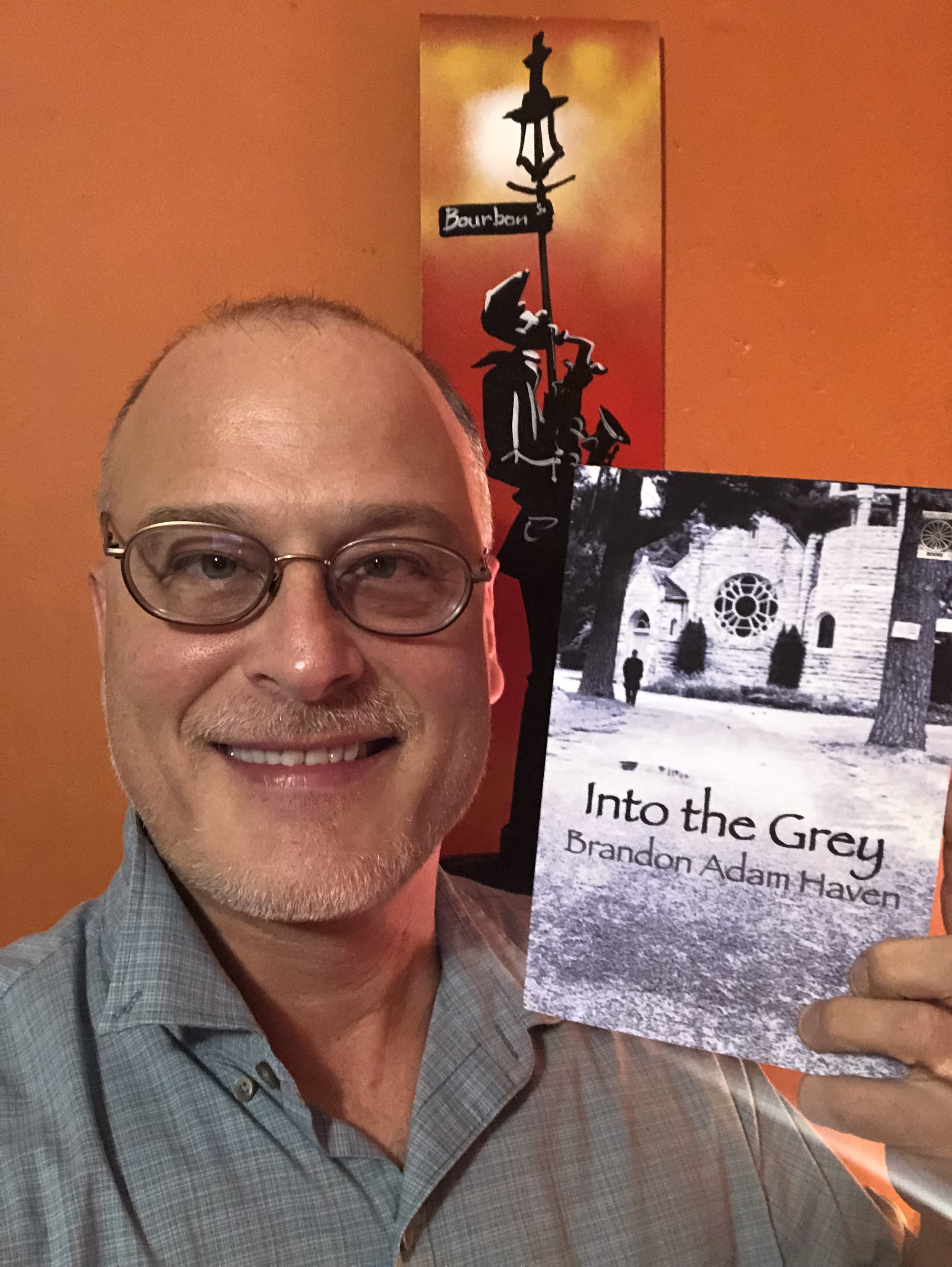
A review of Into the Grey


Some poets you can identify by the first couple of lines if there is something evident worth reading. A word, a thought, an expression, an image… these reverberate emotions familiar and enjoyable to the reader. 


Brandon Adam Haven is one of those poets. 


He remains a distinctive drafter of demonstrating broad spectrums of human feelings, and the reactions to the often wicked world around him.

                                                         —


Into The Grey is as evocative as its title implies, the haunting cover a picture of an old rustic church. The particular “grey” Haven is referring to is not the grey of the church building, or grey skies… It is the grey of etchings in a tombstone which he refers to in the poem Into The Grey,… the etchings of his own name! This is where the author particularly and instantly hooked me with his vivid introspections.


Wheelsong Books is known for its distinctive flavors of poets, each one vastly different than the other in so many ways. Publisher Steve Wheeler once referred to this variation of styles to me as “Apples to oranges.” Yet, in his wry humor and impeccable talent for turning a phrase, he is also referring to the vivacious fruit of the Wheelsong authors. 


Brandon Adam Haven displays the rich sweetness of this fruit in his book, as well as the bitter taste of doubt and despair.


Reflections of joy reverberate sweetly throughout poems such as O’er the Hills which lightly begins “O’er the hills of the jolly green Deep into its calm gentle pasture, Doth a black mountain overlooking foreseen, As all is merry, under the sweet evergreen”.  


This is also subtly well crafted in A Joyous Life, “I shudder within to shed my cracked skin For beauty is hidden in plain sight And so are the days jubilee What a joyous life.”


Many struggles are addressed as well. Themes of helplessness, although melancholy on the surface, take a turn at redemption, if not validation,… for life itself. Quietly addressing a friend’s slow demise is seen in Choosing Death, “Please let me help you to climb from this dread… So your days may brighten instead of choosing death.” 


Childhood abuse, depression, addiction, and homelessness are some of the topics the author explores and bounces unsuspected reactions off… like this line from The Quiet Woods Of Winter, “Why was it me, who had to suffer all of this instead of the mean, judgmental and happy other kids?”


Love sweet love does not escape the authors notice. His is a discreet creative rendering, embellishing romantic notions such as this one in his poem Love, “She is my angel, and my greatest wish, Is to fulfil her life everyday with abundant and lasting bliss. The sweetest taste is from her precious lips, and I will forever treasure her every kiss”


                                                       —


Brandon lives in Rockford Illinois, not too far from where my mother’s hometown is. I recently communicated a number of things with him. I found he is a most humble and sincere young man. His big heart and sense of empathy is immediately obvious. A musician and poet, he exudes the kind of soul that an introspective poet of his caliber should possess, and does so in abundance.


His book is one of hard knocks and lessons learned from a vivid window of learned experience. Many poems dive deep within the depths of despair with a voice that is not only desperate, but also almost lost.  This is illustrated in Silence, “In silence I reside alone weeping this snowbound night staring out my window to the snowy white reflecting how empty are the dreams of life.”


The Outcast portrays his outsider character so well when he cries out “Well away from the laughter and the past. For I am the vermin of the world, I am the outcast.”


There is an effervescence about his dismay that is not only relatable, but alluring. It is through a clever wordplay that he is able to transcend the maudlin into something tangible and useful for all of us. This is encapsulated by these weighted phrases from One Day, “Chastised by mirth ascended at his core. The hour of grim hovers near, We stand together to wipe each other’s tears.”


                                                       —


Into The Grey stands on its own as a poignant perspective on what it’s like to stand on the edge and be able to jump back before it’s too late. The wisdom of knowing better is so much more evident once the wound has been set in so deep. One does not forget. In that very vein, once you read Haven’s brilliant poems, you will not forget this book.


Matt Elmore


You can purchase your copy of Brandon Adam Haven's Into the Grey through Amazon - all links are here on the Wheelsong Books website.


How does Wheelsong contribute to literature?

Artificial Intelligence is a strange one. Often AI makes hilarious errors, and sometimes gets it disastrously wrong. It's like a toddler...